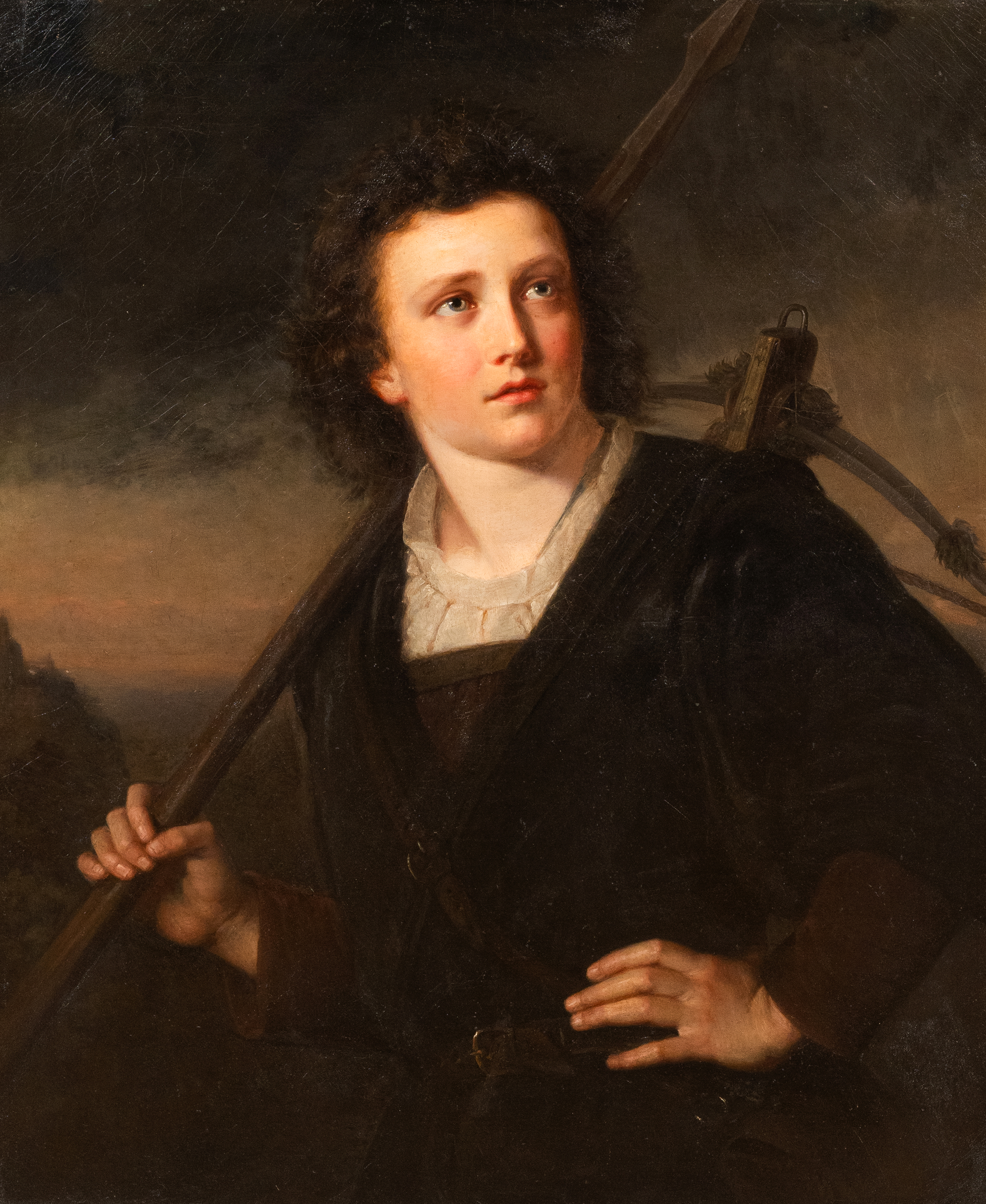
A Young Archer
Albert Kornek
- Artist
- Albert Kornek (Breslau, 1813 – Berlin, 1905)
- Date
- 1880
- Medium
- Oil on canvas
- Dimensions
- H. 78.5 × W. 65.5 cm
- Provenance
- Collection of the artist (stamp on reverse of stretcher)
Sale after the artist's death, Berlin, Rudolph Lepke, 20 February 1905
A painter in the wake of German Realism
Born in 1813 in Breslau, Albert Kornek initially intended to enter the clergy, but his early gift for painting was recognised in the 1830s. He entered the Berlin Academy in 1833, trained under von Klöber, and subsequently joined Karl Sohn's studio in Düsseldorf. He belongs to that generation of 19th century German artists who, in the wake of late Romanticism and the Realist movement, sought to combine naturalistic precision with heroic idealisation.
A portraitist and painter of Romantic subjects inspired by Goethe and folk tales alike, he became a professor in Berlin from the 1840s, working as a portraitist and religious painter for the Prussian court. His work, still little known today, is documented by solid sources: his name appears in Friedrich von Boetticher's catalogue of 19th century German painting, where the Junger Schütze (Young Archer) is listed among his works1.
Between academic tradition and Romantic exaltation
The painting depicts a young archer with a luminous, youthful face, caught in an attitude of pride and momentum. Positioned three-quarters to the viewer, the model carries his weapon across his back, one hand on his hip, his gaze turned toward an unseen horizon. The expression — grave yet dreamy — gives the composition a dramatic intensity.
The palette, dominated by deep browns and blacks, emphasises the brilliance of the face and hands, heightening the contrast between light and shadow. The handling, precise without being rigid, reveals a solid academic training. The figure stands out against a dark background subtly animated by a twilight sky, reinforcing the theatrical effect.
More than a simple portrait, the Junger Schütze belongs to a tradition of heroic youth representations dear to the 19th century. Kornek takes an intimate approach: isolating his archer from any precise historical context, he transforms him into a universal symbol, at once realistic and idealised.
1 Friedrich von Boetticher, Malerwerke des neunzehnten Jahrhunderts, Boetticher's Verlag, Dresden, 1895, pp. 744-745.
2 Der Kunstmarkt, Verlag von E. A. Seemann, Leipzig, 1906, p. 157.