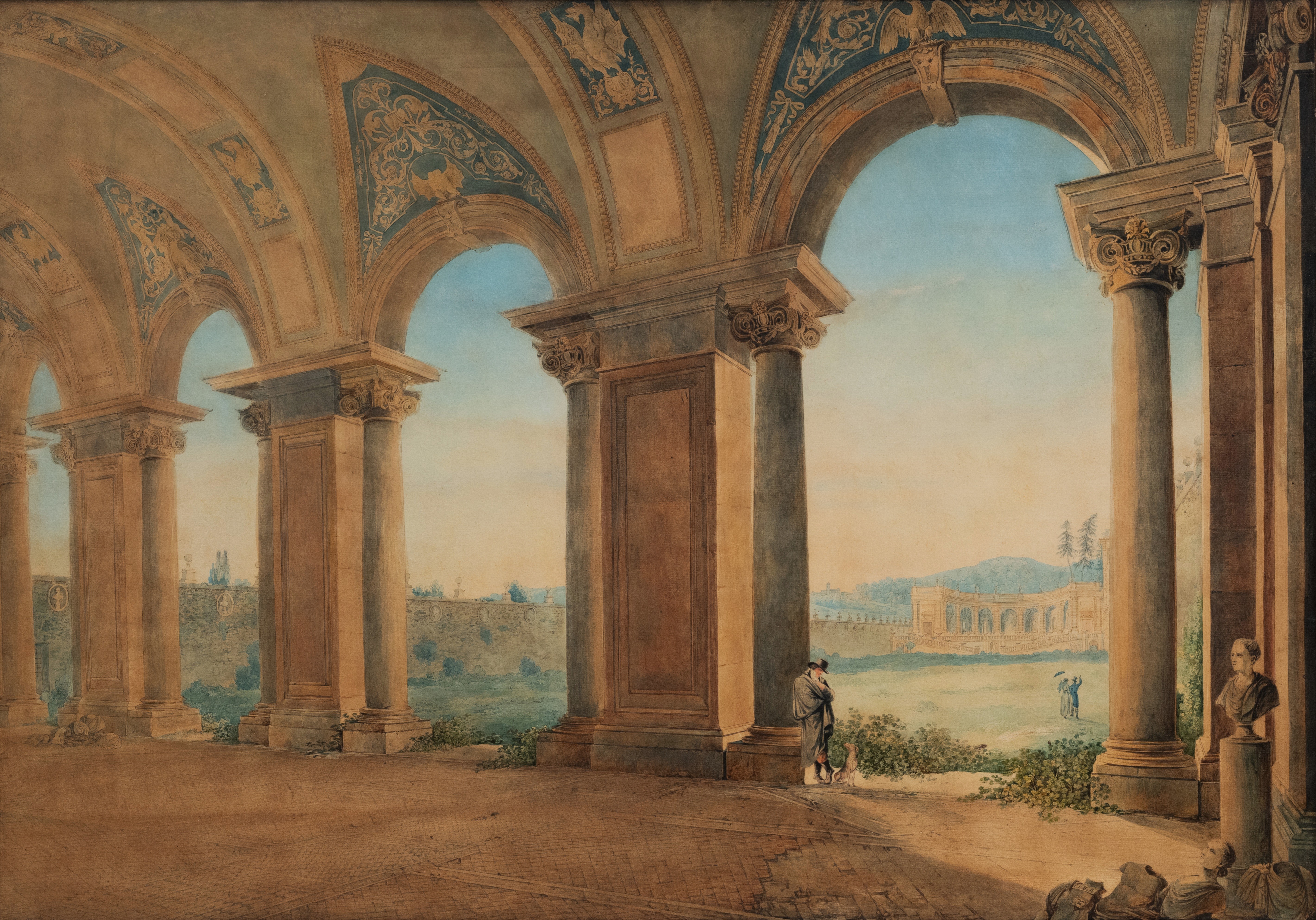
View from the Portico of the Villa Mondragone at Frascati
Abraham-Louis Ducros
- Artist
- Abraham-Louis-Rodolphe Ducros (Moudon, 1748 – Lausanne, 1810)
- Date
- c. 1780–1790
- Medium
- Watercolour, wash and pen on card
- Dimensions
- H. 55.5 × W. 79.5 cm
A watercolourist of the Grand Tour
A Swiss artist trained in the tradition of topographical drawing and observational landscape, Ducros belongs to the pivotal generation that elevated watercolour from preparatory tool to autonomous large-format work. Settling in Rome in 1776 at the age of twenty-eight, he swiftly established himself as one of the most brilliant interpreters of the Italian landscape. His technical mastery, built on layered washes, opaque highlights and assured penwork, allowed him to achieve a breadth and luminous intensity rarely equalled in this medium at that date.
His career was deeply bound to Italy and Rome in particular. His large Roman watercolours met with rapid success among foreign patrons, particularly British, from the late 1770s, notably through his early collaborations with the engraver Giovanni Volpato. With this new partner, he published in 1780 his celebrated Views of Rome and its Environs, a series of large-format contemporary compositions that secured his reputation and helped establish a modern iconography of the city and its countryside.
The Villa Mondragone and its portico
Situated at Frascati, the Villa Mondragone was one of the iconic sites of the Grand Tour. Built on ancient ruins and formerly the summer residence of Pope Gregory XIII, whose heraldic dragon is visible in the arcades of the portico depicted here, it passed into the Borghese family in the seventeenth century, who displayed part of their antiquities there. Studied by the architects Percier and Fontaine, and visited in the nineteenth century by George Sand, it remained in the hands of that illustrious family until the early twentieth century.
This watercolour synthesises the various historical and aesthetic strata that made the villa one of the essential sites of Frascati: Renaissance architecture mingles with ancient fragments piled in the foreground, most likely from local excavations, while the figures animating the scene are dressed in the contemporary fashion of the eighteenth century. The portico acts as a true operatic set, theatrically opening the scene onto the landscape beyond.
Architectural rigour and atmospheric sensibility
The work attests to a quality of execution, graphic precision and monumentality worthy of the greatest watercolourists of the late eighteenth century. The artist displays remarkable care in the rendering of architectural detail: visual passages towards distant follies, meticulous treatment of the coffered vaults, attention to the figures animating the scene, and subtle atmospheric modulations that cast a blue haze over the sculptures and soften the distant views.
In 1790, Ducros took into his service the young painter Franz Keisermann (1756–1833). A watercolour by the latter representing the same subject is known; this version, reflecting a later taste, is enriched with additional figures and columns inserted between the pilasters, with no correspondence to the actual architecture, and does not display the same delicacy of execution. It appears likely to be a commercial replica1.
1 Laura Marcucci and Bruno Torresi, "Declino e rinascita di Villa Mondragone", Saggi in onore di Guglielmo de Angelis d'Ossat, Quaderni dell'Istituto di Storia dell'Architettura, Rome, 1987, pp. 471–490.
2 Pierre Chessex et al., A.L.R. Ducros (1748–1810): paysages d'Italie à l'époque de Goethe, Musée cantonal des Beaux-Arts de Lausanne, Geneva, Éditions du Tricorne, 1986.